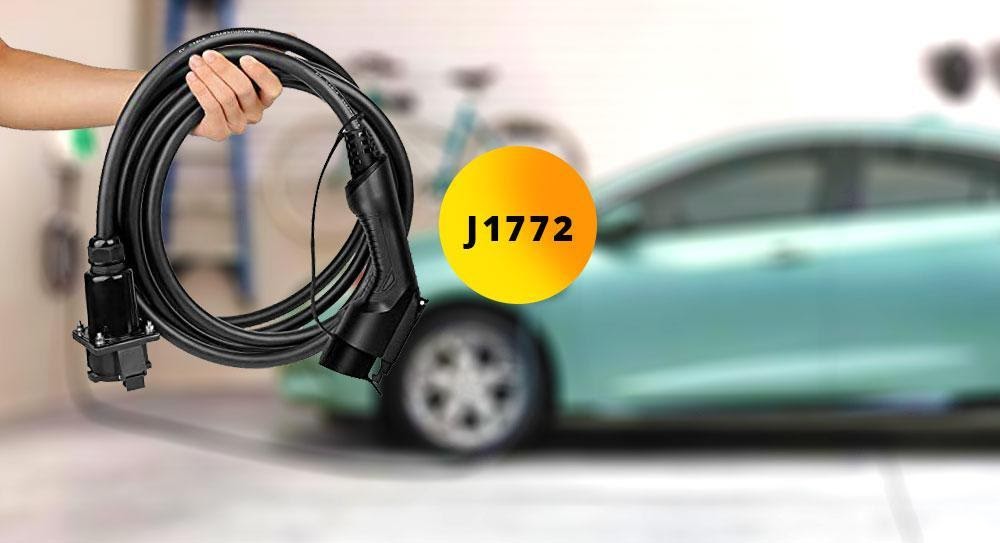
J1772 Extension Cable is a good way to charge your EV. It can be hard to find a charging spot, so this cable will make it easier.
Sometimes we need to charge our electric car, but it might be hard to find an outlet. It could be a place where there are no outlets or the outlets are blocked. So we can use a portable charging station. We might need an adapter cord and it could be far from where we park our car.
Sometimes we are in a bad situation. But there is an option. Use extension cords, power adapters, and portable charging stations to fix the problem.
If you use an electrical extension cord to charge a car, it will be dangerous. But you can do this if you know about electronics and use good quality equipment.
Electricity is everywhere and can power electric cars. You need to charge the car at a charging station. Don’t plug in an extension cord to the car, because there’s safety protection at the charging stations. Using regular chargers sometimes prevents you from using them later on. We should use portable chargers so we can charge our cars anywhere without needing to stop!
When is a J1772 extension cord needed?
- Some entries on the PlugShare map are not for charging stations, but for power outlets that can be used by electric car drivers. You must bring your charging station in that case.
- If the charger is blocked by another car, sometimes you can ask them politely to move and unplug their power cord.
- The charging station may not work with our car. Manufacturers tried to make one protocol, but in North America, there are three protocols used.
What strategies help when you need to charge a car?
- Extension cords can be a helpful alternative for charging stations that are blocked or cannot extend their reach.
- Maps like PlugShare can direct us to nearby locations if we are at the last available charger.
- EV adapters allow us to use charging stations that are otherwise incompatible with our car.
- A portable charging station can be used with available outlets. In some circumstances, you’ll need to know what power outlet is in front of you, its wattage limit, and the appropriate adapter for your device.
It is possible to charge an electric car everywhere because electricity is everywhere. You can charge your car with the right cords and adapters.
To use an extension cord safely to charge a vehicle, you need to know the power outlets and have the appropriate cords. Always plug your charger into the outlet that has less electricity coming from it.
To distinguish between them, parents should remember: The outlets with higher electrical output will be in one row, while the ones on lower output will be spread out across more rows. For some details, see the link.
What tools are available to help with this issue?
- A power adapter lets you connect a portable charging station to an outlet that is different from what it was designed for.
- Regular extension cords can be used to make the charging station reach more.
- J1772 extension cords are used to make the charging station reach farther.
- Portable charging stations are a good idea. They can charge at any outlet.
The J1772 extension cord is designed to handle the power load required to charge an electric car; this makes it nearly impossible for a fire or risk of an electrical burst. If you can’t charge your electric vehicle at a conveniently located power outlet, pack an extension cord built from high gauge wire and has beefy connectors. Before plugging in, inspect the outlets carefully for any damage.
How to choose the best J1772 extension cord?
When searching for J1772 extension cords, know that you will need one with a higher amperage than J1772 chargers can provide to charge J1772-compatible electric vehicles. J1772 extension cords are built for up to 16 amps, while J1772 charging stations and EV adapters all max out at 6 amps.
Check out this expert review from evadept.com on J1772 extension cord selection. https://evadept.com/best-extension-cord-for-ev-charger/ It does a good job of showing what alternatives J1772 has for various electric vehicles.
What is the J1772?
The J1772 standard is a set of rules for how electric vehicle supply equipment (EVSE) connects to the car and provides power to charge it. This includes the link from the grid or household power to the vehicle. The EVSE manages this link and also communicates with the vehicle, called a “smart outlet.” The car is safe because it ensures that the EVSE can only provide power when connected correctly. Even if you use a J1772 extension cord, the car will still make sure it’s safe. All of these standards are not required by any federal agency for you to sell an EV in America, but they have been adopted by all manufacturers of passenger vehicles in other countries.
The car has an AC-DC converter. It changes the power from the EVSE to power the car’s battery pack. The two communicate via a special protocol called J1772.
The original standard was to provide power for charging at 240 volts. Most implementations are less than 30 amps. 120 volts was called “level 1”, and 240 volts is called “level 2.” The current used depends on the vehicle you have. If you have an electric vehicle or hybrid, it may come with its portable J1772 charger that plugs into an outlet.
The J1772 standard and connector provide smart pins that allow for detection of the EVSE plug when connected. The smart pin is used to tell the vehicle how much current is available. As the experts from evadept.com previously reported, a good J1772 extension cord will support data exchange.
The standard was designed so that if a vehicle requires more current than the EVSE can supply, the vehicle can then choose not to charge. In general, this doesn’t happen as the majority of the vehicles require less power.
The choice is yours
The J1772 extension cord is the best way to charge your electric car in a situation where you don’t have J1772 power outlets available. J1772 extension cords will support data exchange; this means that you’ll be able to hook up J1772 charging stations for convenience as well as portable charging stations for road trips.
When shopping for an extender make sure it supports more amps than your device can provide so that there’s no issue of underpowering your vehicle due to a mismatch between the equipment and the J1772 extension cord.